For many B2B businesses, marketing becomes more active long before it becomes more mature.
There are campaigns running. Content is being published. Paid traffic is being tested. The website is being updated. Leads are coming in, at least some of the time.
From the outside, that can look like progress. But underneath, the system is often far less stable than it appears.
Reporting is patchy. Lead quality varies from month to month. Sales and marketing are not always working from the same definition of a good lead. Decisions are made on instinct because the data is either incomplete, disconnected, or not trusted.
That gap matters. Especially as B2B marketing becomes more complex.
The future of B2B marketing will only add to that complexity. We are already seeing more discussion around the industrial metaverse, AI agents, always-on data, connected infrastructure, and increasingly automated prospecting and optimisation.
But most B2B companies are not struggling because they are missing the latest technology. They are struggling because the basics are not yet joined up properly, which is exactly where a marketing maturity assessment becomes useful.
Instead of asking, “Are we doing marketing?”, it asks a better question: how well does our marketing actually work, and what needs to improve before we scale it?
For business owners and directors, that is the difference between investing with confidence and spending more money on activity that looks busy but does not build a reliable pipeline.
What is a B2B marketing maturity assessment?
A B2B marketing maturity assessment is a practical way to understand how developed your marketing really is across the areas that drive growth.
It moves the conversation beyond traffic, impressions, click-through rates, and “how many leads did we get?” Those numbers have their place, but they rarely tell the whole story.
A good assessment looks at whether the foundations are strong enough to turn marketing activity into commercial results.
In practical terms, it helps you answer questions like:
- Do we have a clear strategy, or are we running disconnected tactics?
- Can we trust our tracking and reporting?
- Do we know which leads are profitable, not just which channels are active?
- Are we improving performance over time, or repeating the same activity?
- Is marketing properly connected to sales, CRM, and commercial reality?
For owner-led and director-led B2B businesses, this becomes especially important as the business grows. What worked at a smaller scale often starts to break under pressure. More channels, more spend, more enquiries, and more people involved can quickly expose weaknesses that were previously hidden.
Why maturity matters more than channel performance
When marketing results start to disappoint, the instinct is often to change the channel.
Try more SEO. Spend more on LinkedIn ads. Publish more content. Change agency. Push harder on email. Increase the budget.
Sometimes that is the right move. But often, channel performance is only the visible symptom. The real issue is that the marketing system underneath is not mature enough to sustain growth.
For example:
- More traffic will not help if the website journey is weak.
- More leads will not help if the CRM is underused and follow-up is inconsistent.
- More ad spend will not help if attribution is unreliable.
- More content will not help if the messaging is not aligned to buyer intent.
This is why maturity is such a useful lens. It helps you diagnose the system, not just react to the symptoms.
A less mature marketing setup can still create activity. It can still generate enquiries. It can even produce the occasional strong month. But it is much harder to scale because the business does not yet have enough control, visibility, or consistency.
The four areas that determine marketing maturity
Our digital marketing assessments look at four core areas: Measurement & Reporting, Unit Economics, Optimisation & Testing, and Funnel, CRM & Organic.
Each one tells you something different about how ready your marketing is to scale.
1. Measurement and reporting maturity
Measurement comes first because weak reporting distorts almost every other decision.
If you cannot trust the numbers, it becomes very difficult to know what is working, what is wasting budget, and where the real opportunities are.
A more mature B2B business can answer questions like:
- Which channels generate qualified leads?
- Which leads turn into opportunities and revenue?
- Where are conversion rates strongest and weakest?
- Can we track performance beyond the form fill?
- Do we know what marketing activity is contributing to actual sales pipeline?
An immature setup usually looks different:
- Reports focus on clicks, traffic, or platform metrics.
- Attribution between channels is unclear.
- GA4 or conversion tracking has gaps.
- CRM data does not feed back into marketing properly.
- There is little confidence in cost per lead or cost per acquisition.
This is where many businesses make poor decisions without realising it. They cut campaigns that are influencing sales. They increase spend on channels that generate low-quality leads. Or they judge marketing on numbers that are easy to measure, rather than numbers that matter commercially.
If you cannot trust the data, you cannot scale safely.
2. Unit economics maturity
Many B2B companies talk about lead generation without fully understanding the economics behind it.
That creates risk. A campaign can look successful because it generates enquiries, while still being commercially weak once close rate, margin, sales effort, and customer value are considered.
Mature marketing teams understand the relationship between spend, conversion rate, close rate, customer value, and margin. They know that not every lead is equal, and not every sale is equally valuable.
At this stage, the questions become more commercial:
- What is a lead actually worth?
- What close rate do we need for a campaign to be viable?
- Which services, sectors, or offer types are most profitable?
- Are we optimising for volume, margin, or strategic fit?
- What level of acquisition cost can the business realistically support?
Less mature businesses often chase lead volume without knowing whether those leads create profitable revenue. That can create false confidence. The dashboard looks busy, but the business is not necessarily moving in the right direction.
Good marketing is not just about generating more opportunities. It is about generating the right opportunities at a cost that makes sense.
3. Optimisation and testing maturity
A lot of B2B marketing plateaus because nobody is really testing anything.
Campaigns go live and stay largely unchanged. Landing pages are launched and forgotten. Messaging is adjusted based on opinion. Performance is described as “fine” or “about average”, but there is no clear rhythm of improvement.
That is the difference between active optimisation and simply keeping marketing switched on.
A more mature business regularly tests and improves things like:
- ad creative and hooks
- landing page structure
- offers and lead magnets
- form length and friction
- conversion messaging
- audience targeting
- follow-up and nurture sequences
It also pays attention to market changes, competitor activity, buyer behaviour, and the signals coming back from sales conversations.
The point is not to test for the sake of testing. The point is to create a system for learning.
Without that system, performance tends to flatten. Not because the business has no opportunity, but because there is no consistent process for compounding small improvements over time.
We often describe this as the marketing engine. Once the engine is running, it still needs tuning. The businesses that improve fastest are usually the ones that treat optimisation as an ongoing discipline, not a one-off project.
4. Funnel, CRM, and sales alignment maturity
This is where many B2B businesses either unlock growth or quietly lose it.
Marketing does not end when someone fills in a form. That is only one point in the journey. What happens next often determines whether the opportunity turns into revenue or disappears into the CRM.
Mature businesses connect demand generation to lead qualification, CRM usage, sales process, follow-up, and revenue feedback.
Key questions include:
- Are leads followed up consistently?
- Are marketing-qualified and sales-qualified leads clearly defined?
- Is CRM data clean, current, and useful?
- Can marketing see which campaigns drive real pipeline?
- Are you building owned audiences, rather than only renting attention from paid channels?
If the handoff between marketing and sales is weak, performance becomes difficult to read.
Marketing may appear to be underperforming when the real issue is poor follow-up. Or it may appear to be working because lead numbers are strong, while sales teams know the quality is not there.
Either way, the business is left making decisions from partial information.
A simple 3-level maturity model for B2B owners
Every business is different, but a simple three-level model can help you understand where you are starting from.
The reality is usually more nuanced, but this gives owners and directors a useful first view of what needs attention.
Level 1: Stop the leaks
At this stage, marketing is active but not properly controlled.
Common signs include:
- tracking is incomplete
- lead quality is inconsistent
- website conversion paths are weak
- campaign performance is difficult to validate
- budget decisions are reactive
This business should be cautious about scaling aggressively. More spend may simply make the waste bigger.
The priority is to fix measurement, understand the commercial numbers, and remove the most obvious leaks in the journey.
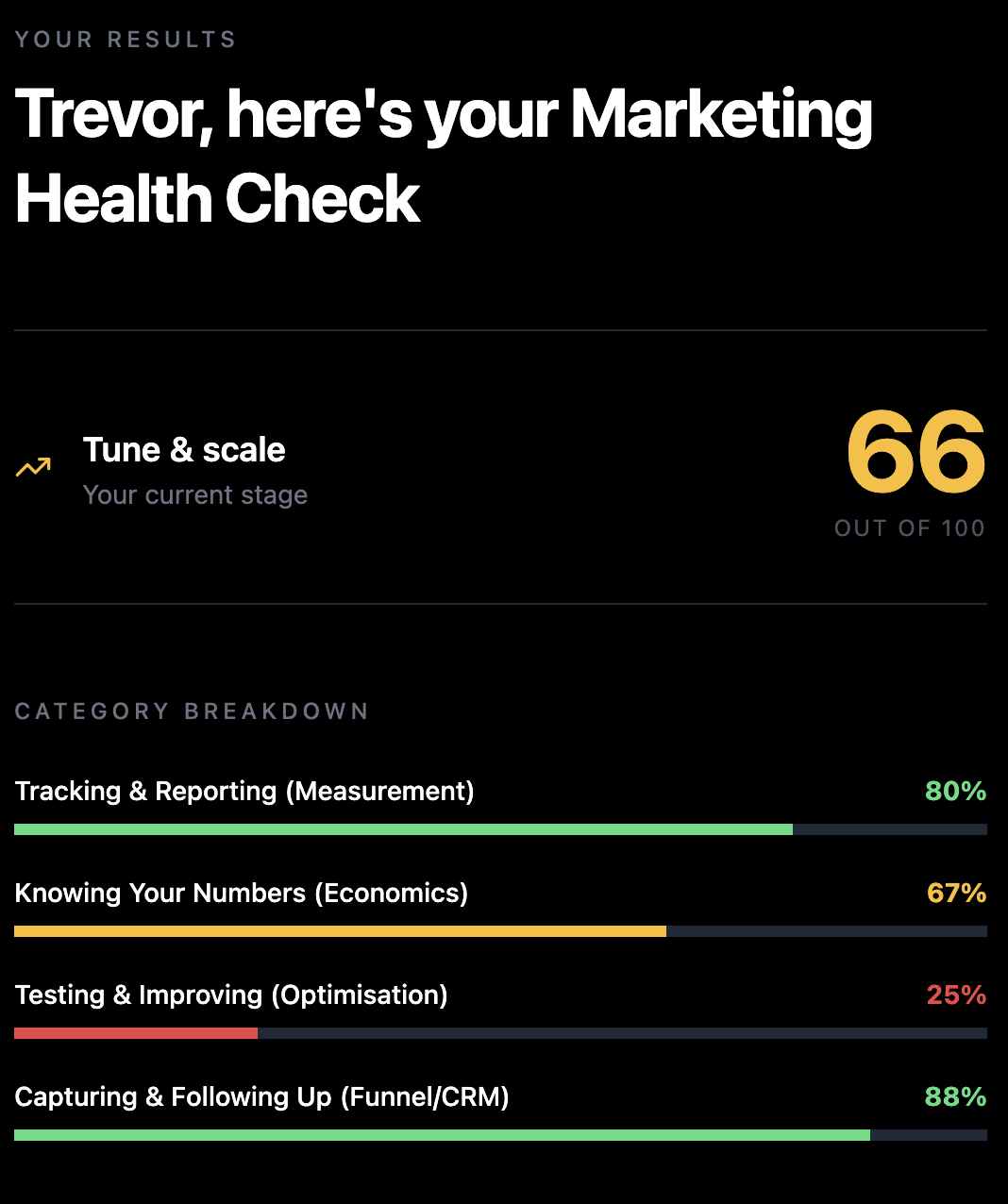
Level 2: Tune and scale
At this stage, the basics are in place, but growth has started to slow or become inconsistent.
Common signs include:
- some reporting exists, but attribution is still imperfect
- lead generation works, but not predictably enough
- sales feedback is inconsistent
- landing pages and campaigns are rarely tested in a structured way
- there is opportunity, but not enough clarity on where to push next
This business usually needs sharper optimisation, better benchmarking, and a stronger feedback loop between marketing and sales.
The aim is not to start again. It is to improve the parts of the system that are already showing signs of potential.
Level 3: Scale with confidence
At this stage, the business has a more mature marketing engine.
Common signs include:
- clear visibility of what drives opportunities and revenue
- disciplined testing and optimisation
- a stronger commercial understanding of profitable growth
- better CRM integration
- clearer decisions about where to increase investment
The challenge here is less about fixing obvious gaps and more about improving efficiency, expanding intelligently, and increasing velocity without losing control.
This is where marketing can become a genuine growth asset rather than a collection of disconnected activities.
How to assess your own marketing maturity
You do not need a 50-page report to get started. A practical assessment can begin with a few direct questions.
Strategy
- Do we have a clear growth objective for marketing this quarter?
- Are our channels tied to that objective, or are they running because they always have?
- Do we know which audience segments and offers matter most?
Measurement
- Can we trace leads from source to opportunity to sale?
- Are our dashboards showing business outcomes, not just activity?
- Do we trust our data enough to make budget decisions from it?
Commercial understanding
- Do we know our lead-to-sale rate?
- Do we understand customer value and margin by offer?
- Can we define what an acceptable acquisition cost looks like?
Optimisation
- What have we actively tested in the last 90 days?
- Which conversion points are underperforming?
- Do we have a process for improving campaigns and pages over time?
Sales and CRM alignment
- Are leads being qualified consistently?
- Is CRM data feeding back into marketing decisions?
- Do sales and marketing agree on what “good” looks like?
If too many of those answers are vague, your maturity level is probably lower than your activity level suggests.
That is not unusual. Most businesses become active before they become mature. The important thing is recognising the gap before adding more budget, more channels, or more complexity.
What to improve first
If your marketing feels messy, resist the urge to fix everything at once.
In most B2B businesses, the right order is:
- Measurement first
Fix tracking, attribution, and reporting gaps so decisions are grounded in evidence. - Commercial clarity second
Understand lead quality, close rates, margin, and what profitable acquisition actually means. - Optimisation third
Improve the website, landing pages, campaigns, and messaging through regular testing. - Sales and CRM alignment fourth
Tighten the handoff so marketing performance is judged on real business outcomes.
That sequence tends to produce better results than jumping straight into more spend or more content.
Before you scale activity, you need to know where the system is leaking, which numbers can be trusted, and what kind of growth is actually worth pursuing.
Benchmark your marketing before you scale it
If you are a business owner, director, or marketing lead in a B2B company, a marketing maturity assessment gives you something more useful than another list of tactics.
It gives you perspective.
It shows whether your marketing is ready to scale, where the bottlenecks are, and what should be fixed before more budget is added.
At Red Balloon, we have created a fast online assessment tool to help businesses understand the health of their marketing engine. Our free Marketing Health Check gives you a scored breakdown across the key areas of a mature marketing system, along with practical next steps based on your answers.
It takes around five minutes to complete and gives you a clearer view of where your marketing is strongest, where it is weakest, and what to work on first.
Take the Free Digital Marketing Assessment.